

Antenna gain
| Antenna gain | |
|---|---|
| What it measures | How much stronger an antenna's signal is in its best direction than a reference antenna's |
| Units | dBi (over an isotropic radiator) or dBd (over a half-wave dipole) |
| Conversion | dBd = dBi − 2.15 |
| Made up of | Directivity, reduced by the antenna's own losses |
| Related terms | |
| ERP | Power at the antenna times its gain over a dipole |
| EIRP | Power at the antenna times its gain over an isotropic radiator |
| Beamwidth | Angle between the half-power (−3 dB) points of the main lobe |
Antenna gain describes how strongly an antenna sends and receives in its favored direction, compared with a reference antenna. An antenna is passive and cannot create power. Its gain comes entirely from concentrating energy in some directions at the expense of others, the way a flashlight's reflector makes the beam brighter without a bigger bulb. Gain is expressed in decibels, and it works on both transmit and receive: an antenna that makes a signal 6 dB louder in Europe also makes European signals 6 dB louder at home.
dBi and dBd
A gain figure only means something when its reference is stated. Two references are in common use.
- dBi compares the antenna with an isotropic radiator, an imaginary point source that radiates equally in every direction. No real antenna can do this, but it makes a convenient zero.
- dBd compares the antenna with a half-wave dipole in free space. A dipole has 2.15 dBi of gain, because it radiates more strongly broadside than off its ends.
To convert, dBd = dBi − 2.15, and dBi = dBd + 2.15. A Yagi rated at 7 dBi has about 4.85 dBd, or roughly 5 dB over a dipole. The same antenna can therefore be described by two numbers 2.15 dB apart, and the higher one is always the dBi figure.
| Antenna | Gain (dBi) | Gain (dBd) |
|---|---|---|
| Isotropic radiator (theoretical) | 0 | −2.15 |
| Half-wave dipole, free space | 2.15 | 0 |
| Three-element Yagi | About 7 | About 5 |
| Long-boom 2-meter Yagi | Up to about 15 | Up to about 13 |
Every 3 dB of gain doubles the effective power in the favored direction, so a beam with 6 dB more gain than a dipole has the same effect there as multiplying the transmitter's power by four.
-
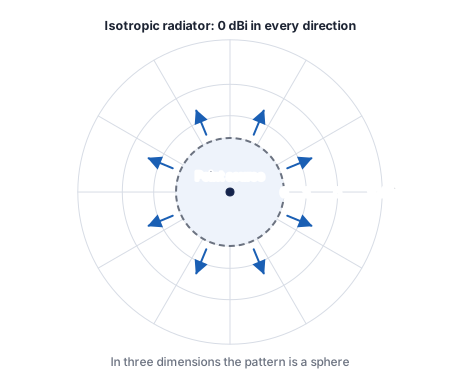 The isotropic radiator: a theoretical point that radiates equally in every direction.
-
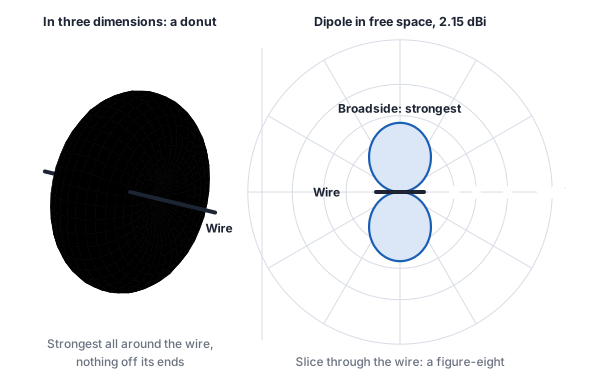 A dipole in free space radiates in a donut shape, strongest broadside to the wire.
-
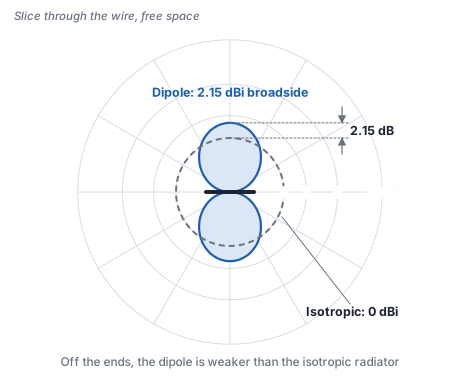 Broadside, a dipole reaches a little over 2 dB farther than the isotropic radiator. That is its gain in dBi.
-
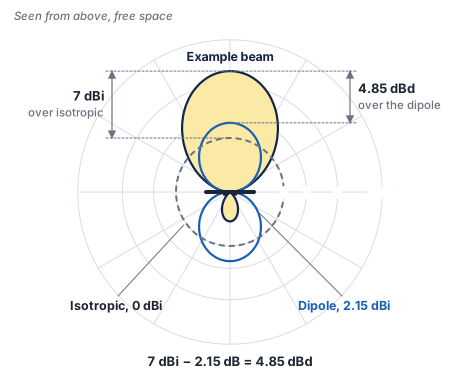 A beam's gain over a dipole (dBd) is its gain in dBi less the dipole's own gain.
-
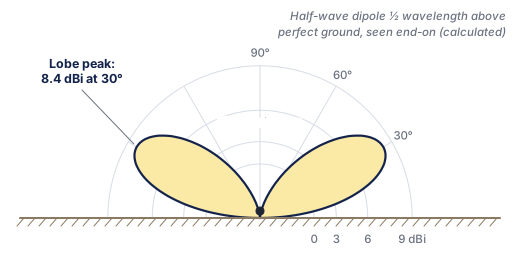 Near the ground, reflections gather the pattern into lobes.
-
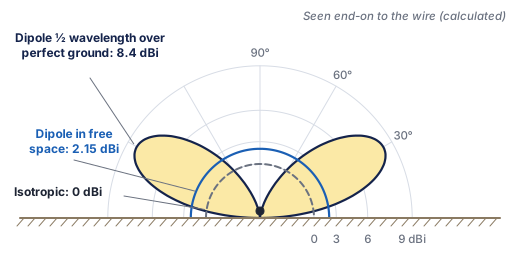 All three together. Calculated over perfect ground, the dipole half a wavelength up reaches 8.4 dBi in its lobes, about 6 dB more than in free space, purely because of the ground beneath it.


Directivity and gain
Directivity describes only the shape of the radiation pattern: how much the antenna concentrates energy in its best direction compared with spreading it evenly. Gain is directivity reduced by the antenna's own losses, such as resistance in the elements, traps and loading coils, and losses in the ground. In decibels, gain equals directivity minus loss. An antenna with a directivity of 5 dBi that is only 50 percent efficient loses 3 dB, so its gain is 2 dBi.
The difference matters most for small antennas. A very short, coil-loaded antenna has almost the same pattern as a full-size dipole, and so almost the same directivity, but much lower gain, because much of the power heats the coil instead of being radiated.
Real antennas also sit above real ground. Reflections from the ground can add as much as about 6 dB at some elevation angles compared with the same antenna in free space. Some published figures include that boost and some do not, so compare free-space figures with free-space figures.
ERP and EIRP
Effective radiated power (ERP) is the power delivered to the antenna multiplied by the antenna's gain over a dipole. Effective isotropic radiated power (EIRP) uses the isotropic reference instead. Because a dipole has 2.15 dBi of gain, a factor of about 1.64, EIRP is always about 1.64 times the ERP.
A worked example: a transmitter puts out 100 watts into a long run of feed line that loses 3 dB, so 50 watts reaches the antenna. The antenna has 6 dBd of gain, a factor of 4, so the ERP is 50 × 4 = 200 watts and the EIRP is about 200 × 1.64 = 330 watts. In decibels, the same sum is simpler: −3 dB + 6 dB = +3 dB, double the transmitter's 100 watts.
ERP is more than a curiosity. US power limits on the 60-meter band are stated as ERP, and an RF exposure evaluation has to take antenna gain into account.
Gain and beamwidth
Because gain comes from narrowing the pattern, more gain always means a narrower beam. Beamwidth is the angle between the two directions in which the signal falls 3 dB below its peak, called the half-power points. A small HF beam is forgiving to aim; a long VHF Yagi must be pointed accurately, which is why directional antennas usually go with rotators.
Antennas described as omnidirectional can also have gain. A VHF collinear vertical covers all compass directions equally but squeezes its pattern toward the horizon. That suits a station on flat ground working distant repeaters, at the cost of coverage at higher angles.
Reading gain claims
Gain figures in advertisements need care.
- Check the reference. A figure in plain "dB" with no reference is usually dBi, and may also include ground reflection.
- Be wary of small antennas with big numbers. Gain requires size. A compact antenna cannot concentrate energy much, and a shortened HF mobile whip claiming gain over a dipole deserves skepticism.
- Low SWR is not gain. A wide, flat SWR curve can be a sign of loss. A dummy load has a perfect SWR on every band and radiates almost nothing.